How to Write a Song About Your Life Without Fear: 6 Simple Steps
Table of Contents
Why Write a Song About Your Life?
There’s a real advantage when you write a song about your life: you lived it. Every experience is first-hand, so no one else can tell it the way you can. Your perspective is unique, and that’s exactly what makes a personal song worth hearing.
Whether the memories are happy or painful, the goal is the same: capture something meaningful that your listeners can feel.
To write a song about your life, you have to turn years of memories into about three and a half minutes. That means choosing what to keep, what to cut, and how much of yourself to share. These six steps take you from scattered memories to a finished personal song.
Step 1: Get Every Memory Out
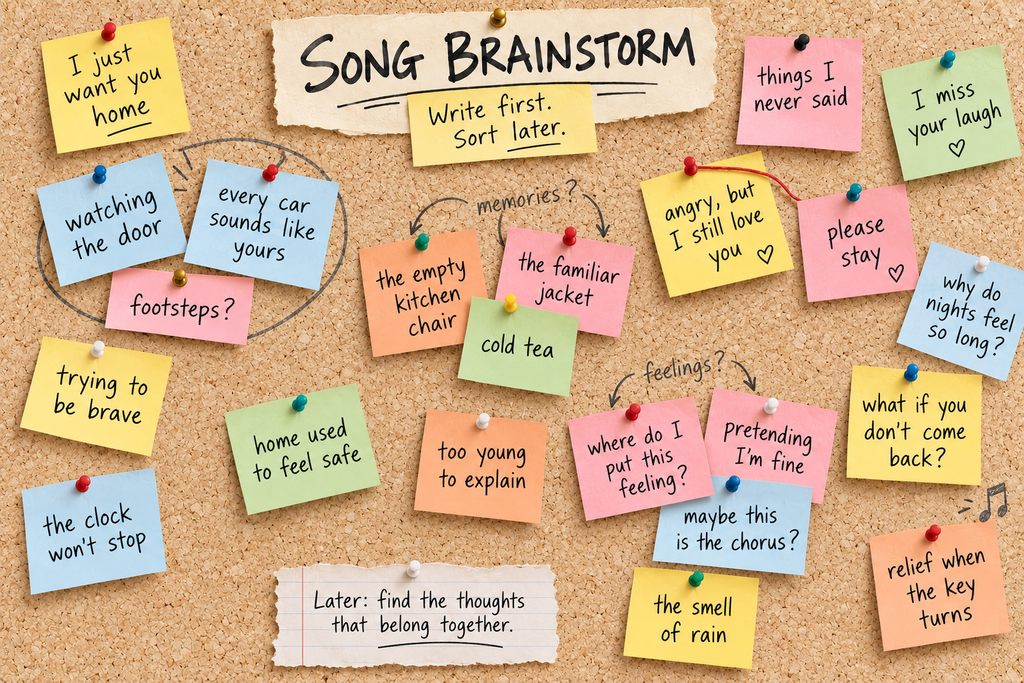
Don’t worry about getting it right. When you first write a song about your life, the hardest part is starting, so make it easy. Write down every memory as it comes, one per sticky note, and pin them to a board. A sound, a room, a smell, a sentence someone said. Nothing is too small.
Step 2: Find the Core Emotion
Now group the ideas. Move them around until related memories sit together. Patterns appear, and with them a shape: a beginning, a turning point, an ending.
Find the core emotion. Now, ask the most important question: what is the one feeling this song is really about? Fear, longing, love, forgiveness? Most of your time will go into editing, cutting and narrowing until only that core emotion is left. That’s often where you’ll find your song’s title.
Step 3: Choose Your Tense
You don’t have to tell a past story in the past tense. Writing it in the present tense, known as the narrative present, brings the listener straight into the scene. Instead of explaining what happened from a distance, you let them stand inside the moment.
You can also move between past and present, as long as the change has a purpose. Try both versions, play them back, and listen carefully. Which one sounds natural? Which one hurts more?
Step 4: Try Emotional Juxtaposition
Sad lyrics don’t always need sad music. Placing painful words over an upbeat, feel-good rhythm creates a contrast that draws the listener in. They start dancing, then they hear the words, and the song hits twice as hard.
It’s also true to life. That’s how many of us survive hard times: we carry sadness and still dance, create and keep moving.
Step 5: Get the Feeling Right, Not Every Fact
When you write a song about your life, you won’t capture everything exactly as it happened, and you don’t need to. Memory isn’t a recording, and a song has to compress years into minutes. What matters is getting the feeling right: the moment, the hurt, the love, the thing you truly want to say.
If the heart of the song is honest, it’s a true song, even if some details have shifted.
Step 6: How to Write a Song About Your Life Without Fear of Being Judged
When you write a song about your life, the questions come quickly. Why would anyone care about my story? What would listeners feel? Could this song ever belong in a film or television scene, or would it sound like a private therapy session set to music?
With tools like Suno, anyone can turn their feelings into a finished song in minutes, and using a song as your own therapy is a wonderful thing. Go for it.
I once heard a story about a doctor who spent years saving lives. In all that time, he never talked to anyone about what he'd seen on the job. Finally, he decided to try therapy. He found a very senior psychologist and, one Friday, unloaded everything. He walked out feeling lighter than he had in years. On Monday, the psychologist died. That man was convinced he'd caused it.
There’s a little songwriting lesson in that. If you want to share your song, try not to kill your listener.
A song you release should give the listener something back too. Let’s be honest: we’re all a little selfish online. It’s the first rule of marketing. Every listener is asking, “What’s in it for me?”
Here’s what helps:
- Honesty is what connects. Listeners don’t relate to your exact story. They relate to the feeling, and they recognize their own story inside yours.
- You choose what to share. You don’t owe the listener every detail. One true moment can say more than the whole history.
- Shape it for the listener. When you cut what only matters to you and keep what anyone can feel, your story becomes theirs too.
- Be true to yourself, then shape it with craft. Producer Rick Rubin, in his book The Creative Act, encourages artists to make work that honestly reflects who they are, rather than chasing what others might want. But being true to yourself doesn’t mean telling everything, raw and unfiltered.
- Songwriting is a craft, and the craft is what turns your truth into a song someone else can feel.
Honesty decides what you say. Craft decides how you say it.
Raw vs. Crafted: Two Examples
“Love Is a Battlefield” (Pat Benatar)
- What it means: Love is hard. It hurts, and you have to fight for it.
- Written plainly: Relationships are difficult and painful.
The plain line sounds like a complaint. The battlefield gives the listener room to bring their own feelings into it: their own fights, wounds, and reasons to stay.
Edit, Test, and Edit Again
Some songwriters dislike editing a song over and over, and some listeners in songwriting groups lose patience hearing version after version. But reworking a song is where the real learning happens.
This is where AI tools like Suno shine. While you’re still crafting the song, you can hear it in a new genre or with rearranged lyrics in minutes, without paying for a musician’s time or a recording session. Use that freedom. Try your song as a ballad, then as rock. Move a verse. Cut a line. Every version teaches you something about what the song needs.
Each time you edit, ask yourself:
- Does it flow? Is the song cohesive and smooth from start to finish?
- Does it have an emotional core? Is there one feeling holding it together?
- Does it draw the listener in? Or does it read like a list of diary entries?
- What should the listener feel? What’s the main message?
- What’s universal? It’s your story, but what feeling would anyone recognize?
Your Turn: Write a Song About Your Life
To write a song about your life, you need one true memory, a stack of sticky notes, and a willingness to edit. Start with Step 1.
Keep learning:
- Metaphors in Song Lyrics: 3 Easy Ways to Write Them
- How to Write Melodies (Without Music Theory) for Beginners
I hate the night.

I was inspired by Pink's "Family Portrait." It's raw and honest, and it made me wonder if I could write about my own childhood growing up with a father who drank.   So I wrote "I Hate the Night."

A year later, I redeveloped the song with a melody I developed myself. [See how I wrote the melody without music theory.]
If this brings anything to mind, I’d love to hear your thoughts in the comments below. You can use a nickname if you prefer. Emails and websites are not requied.